You are not broken. You are just incomplete.

Break containment. Build the life you always wanted.

Three hundred and ninety pages make a case for the life you have not been able to build, and the system that builds it.

You have read all the productivity books. You have followed the morning routines. You have absorbed the podcasts and the threads and the lectures. The vocabulary and ideas loaded; the ability to make them work did not. You have not been lazy; you put serious effort in, and that effort is not lost or forgotten. The knowledge is in your brain, waiting for the substrate to make it operational. This book shows you what is missing.

There is a shelf in your home, or a folder on your phone, or a list in your bookmarks. The contents are similar from one man to the next: the productivity systems, the men’s-development content, the books on stoicism and discipline, the long-form videos you watched twice. The shelf is full and yet you are still working on the same problems.

You can describe the problems you face. You can describe the patterns that are tripping you up. You can explain to a friend exactly what he ought to do. And yet you cannot make yourself do it. The gap between knowing and doing is what is holding you back.

The books and videos and seminars and coaching you bought are all aimed at the same mid level depth of development. The layer underneath them is what is missing. The layer that makes it all work. This book builds the case for the missing layer. Our course teaches you how to install it.

Most of the men you know do not know each other well enough to call. Most men today do not have anyone they can rely on, not even a single man they could call in an emergency.

They have no older mentor to teach them the things they do not know, and most of the places where men historically found that kind of support, places where it was abundant and freely available, have been destroyed.

Men are more alone today than at any other point in history.

Your native masculine traits (sex drive, the desire to compete, ambition, anger, directness, hierarchy, physical courage) get coded as conditions to process in therapy rather than as capacities to train for use. You arrived at adulthood undertrained, with no inheritance to stand on, with no fraternity to admit you, and with the wider culture telling you that what you natively are is the problem. The package has a name for the condition. It is containment.

Break containment. The condition was produced to keep you helpless. You arrived at adulthood inside it. The work is to become the man who walks out of it.

Almost everything you want from your life is locked behind two doors. The first door is Personal Sovereignty: the ability to rule yourself, your impulses, your emotions, your beliefs against reality, the direction you give your week. The second door is Federation: the ability to cooperate with capable men around shared work. Behind the two doors are the job that pays you what your work is worth, the income that becomes a household, the woman whose sustained respect survives daily life, the political weight that defends what you build, and the friendship of men who would arrive at your door the night you needed them at your door. Both doors are necessary. Neither alone unlocks the life.

You only get through the second door if you are valuable AND visible. Become the kind of man federations want. The book spells out the case for what makes a man valuable; the course installs that value across a year of weekly work. Visibility is yours to decide on later, in the way your conduct now points you toward. You will get recruited into a federation if you are valuable and visible.

The arrival point is the kind of man capable men admit into their inner sphere. The kind of son who can stop being the family’s emergency plan. The kind of brother whose presence sets the boundary the family has needed. The kind of man whose conduct points to his competency and virtue. The man who other men want to invest in and good women are drawn to.

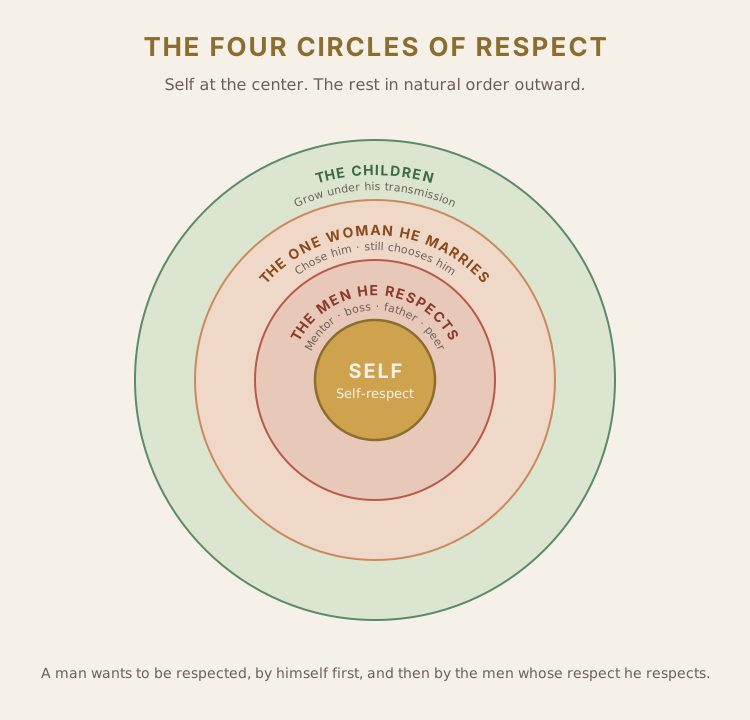
Underneath the money, the happy marriage, the trade, the career, the confident bearing, what every man you have admired had was respect. Each surface want (the money, the woman, the career) is a manifestation of the same underlying want every man across the history of men has felt. A man wants to be respected, by himself first, and then by the men whose respect he values.

The want has four circles, with self-respect at the center; the three external circles develop from it.

The four circles of respect. Self at the center; the men he respects in the second ring; the one woman he marries in the third; the children in the fourth.

Self-respect comes first. You hold your time, your body, and the promises you have made to yourself in high esteem, because they are the foundations of your strength and freedom. The men you respect, peers and older men, are the operational center of the external circles. The woman you marry is the sustained respect that survives daily life. The children you raise read self-respect in their father before they can articulate the word. The respect a man transmits is the inheritance he leaves.

“But the world is broken. It was broken before I got here.”

You may not have caused this. It may not be your fault. You may not be to blame. You are still the only one who can fix it, and the only one who cares enough to fix it for yourself.

Your father did not teach you. Maybe he was absent, and you never had the chance to learn from him. Or he was in the house and not really present as a father. Or he tried and could not do it, maybe his father never showed him how. Or he could have done it and did not care to. Perhaps he was strong and competent on the outside, gave you a good example, but you never saw the interior from which the teaching would have come.

Whichever of those was your father, the developmental work he was meant to do did not happen. The system did not catch what he missed. In many places, the system taught you the opposite of what you needed. The verdict you have been carrying about your own worth, the verdict you absorbed when the man whose job was to invest in you did not invest, was a verdict you did not earn. Refusing it is now your responsibility.

“I feel like I have worked so hard and invested so much into self-improvement, and yet I have almost nothing to show for it. What is wrong with me?”

You are not lazy. You are at war with yourself.

The parts of you that would do the work are fighting the parts that would not. The masculine energy that should be firing you up and powering your life is consumed by the inner fight. The course’s name for the end of the war is Internal Federation: the parts of you cooperating, the man himself ruling because the parts have stopped fighting for control. A man at war with himself is exhausted, he cannot federate with other men. Now you must end the war.

What you get from the book.

The book makes the case for the missing layer of adult capability, told through the lives of four young men who built what you have not yet built. You receive the vocabulary, the inner architecture at depth, and the underlying solution you have been unable to assemble from every other source. A year that changes them for life appears on the page in prose you can read in a few hours.

Who you become from the course.

The course installs the substrate (skills and competencies) that the book discusses. The man you are at year-end is a man whose conduct meets the demands of his life. You will have done the same type of work that produced results for the four men in the book, in your own specific life. The substrate is yours across the decades that follow, because you trained the skills, and now you own them for life.

We call the system you will learn the Adult OS. A structure of eight trainable skills, and a year-long architecture for learning them. To see how it fits together, the architecture is explained here.

What this process looks like in real life.

The four men below are composites drawn from a decade of Noah Revoy’s one-to-one coaching practice. Every entry condition, every felt-experience, every domain shift is from real work in real sessions. Names and details have been mixed and changed until no individual is recognizable.
  • Daniel

    22

    Before

    He has read fifteen books on how to advance his career and has not enrolled in a single course. Each time he opens his browser, the certification page that would help him earn more money is still bookmarked, and the same dread he felt fourteen months ago surfaces again, fresh. He watched the promotion go to the louder colleague; the rage that followed had nowhere to go, because the conversation that would have changed his position kept getting avoided. The rage turned inward and became contempt for himself. His mind is in the top decile and his paycheck is in the bottom; the humiliation of being intelligent and broke hurts every day. The man he could be is locked behind a wall of missing skills, and the gap between who he is and who he could be is closing him up inside himself.

    The skill

    The breakthrough skill was the capacity to sit with the discomfort of a decision long enough to settle himself and follow through. With the wall down, the rest of the work came online inside the same year.

    After

    At twenty-three, Daniel is moving forward in a life he is choosing for himself. The certification is on his wall after a year of consistent work, and opening that browser tab now brings him the satisfaction of work completed. The senior-track offer on his desk pays him what he is worth; the vindication of capacity finally meeting compensation comes through in every paycheck. He had the conversation he had been avoiding for a year and got what he asked for; he acts on the things in front of him now. He keeps the promises he makes to himself, and the man in the mirror has his respect. His father Glen, the man whose respect he most wanted, takes his calls and treats him as a man with a life of his own. The man he could be is the man he is now; Daniel has room to breathe, and the years ahead are his to build.

  • Marcus

    29

    Before

    He runs his career competently and feels adequate at it, and the adequacy feels like slow suffocation. His girlfriend Kate has been waiting on his commitment for a year; he wants to marry her, he does not feel ready, he cannot say what ready would look like, and the mental and emotional loop circles without resolving. Kate brought her Denver promotion opportunity to him as a question about which direction they were moving in; his silence gave the answer for both of them; she withdrew her name and told him it was fine; she was hurt and beginning to give up on him. He heard the lie and did nothing. His father James built an electrical business from a van at twenty-four, coached his soccer team, fixed things, made fatherhood look like something a man simply does when the time comes; Marcus stands in that shadow and feels permanently smaller. The man Kate is waiting for is the man Marcus is becoming but too slowly, and the slowness costs Kate the years she would have spent building forward with him.

    The skill

    The breakthrough skill was the capacity to hold a position when friction rises: to stay in the conversation when his instinct was to go quiet, to commit before certainty arrived, and to stand by what he said when it was pushed against. He had been deferring on the big questions because the holding was the missing competency.

    After

    At thirty, Marcus is the man Kate has been waiting for. He had the conversation with his father about whether James had been sure when he committed; I was terrified, James said, and the shadow lifted: James was just a man, like Marcus, who had been afraid and acted anyway. In month nine, Marcus and Kate sat at the kitchen table with a calculator and ran the actual numbers on the life they wanted, line by line: income, savings, the engagement ring, the wedding, the house. The numbers were tight and workable; ninety minutes later they had a joint plan. The senior-track offer pays him what he is worth; the savings line for the engagement ring grows every paycheck; the satisfaction of building a life with Kate is the deepest thing he feels every day. He keeps the promises he makes to himself, and the man in the mirror has his respect. The doubt that used to circle without resolving still surfaces under pressure. Marcus notices the doubt now and acts anyway. The years ahead are his and Kate's to build.

  • Connor

    25

    Before

    Connor has not slept seven hours straight in two years. He decides repeatedly to stop carrying everyone else's burden, and the decision evaporates the moment someone needs him; each capitulation is a small private failure he feels but no longer counts. His savings have drained from eight thousand to under two; he is bleeding cash and cannot stop. The basketball in the hall closet has not moved in seven months; the man who used to play it is somewhere inside him under all the weight he has been carrying for other people. His girlfriend Laura used to suggest things on Saturdays; she stopped suggesting after the fourth cancellation in a row. She has stopped expecting him to show up. Connor has not yet noticed. Under the exhaustion, the sentence he never says out loud and treats as true: if I stop helping, I am worthless.

    The skill

    The breakthrough skill was the capacity to take responsibility for what was his and refuse fault for what was not: to ask whose problem it actually was before picking up the phone, to stop covering for everyone else's adulthood, and to hold the no when the family pressed back. He had been running his family as if every failure was his to repair; the work was learning when to say no.

    After

    At twenty-six, Connor sleeps seven hours most nights. The savings have stopped draining and climb slowly now; each climb is the satisfaction of money saved for his own life, his own future. The basketball is back on the Sunday morning court. In month ten, the two conversations Connor had been rehearsing for years both happened: he told his brother Jake at the diner he was done covering the rent, and he told his father Mike in the shop on a Sunday morning he was stepping back from the business work. He held the line both times and both adapted. The relief of saying no and being heard runs in his body every day now. His girlfriend Laura suggests things again, and her voice is happy and hopeful because Connor is present again. He keeps the promises he makes to himself, and the man in the mirror has his respect.

  • Ryan

    19

    Before

    Ryan games six to eight hours a night, the vape always within reach; what he is reaching for is the numbness that lets the day pass without him having to feel anything. He sits in the parking lot of the hardware store for thirteen minutes before every shift, scrolling, the engine off; the dread of walking in fills the minutes. From the outside Ryan looks fine: no crisis, no drugs, no visible failure. Inside, the emotional numbness keeps him going through the day and a feeling of constant suffocation is the cost of it; underneath both, there is a grief he cannot describe which terrifies him every time it surfaces. His father has been gone since Ryan was two; no man has lived in his house since, and he has been making it up from screens and silence, with no one to show him how to become a man himself. His mother Sarah works two jobs; the faucet washer in the kitchen has needed replacing for two weeks and he knows where the wrench is and yet he sits at his desk while she kneels on the tile trying to figure it out; the shame surfaces every time he sees her struggle with it. On the Saturday she had a doctor's appointment and her car was in the shop, she raised her hand to knock on his door, hoping to borrow his car, held it there, and then walked to the bus stop; Sarah has stopped counting on him, and Ryan has not yet noticed.

    The skill

    The breakthrough skill was the capacity to act on what he had been seeing all along: to fix the faucet his mother could not fix herself, to walk into the place he had been avoiding, and to ask for the help he needed from the men around him. He had been observing accurately for years; the work was building the connection between what he saw and what he did.

    After

    At twenty, Ryan is moving forward in a life he is finally choosing; he can feel his own days landing on him now, and he meets them. He works Jim Kelsey's framing crew Monday through Friday, six to three; last week Jim let him frame a closet wall alone, and the satisfaction of building something is the best feeling Ryan has had in his life. His mother Sarah dropped her Friday cleaning shift, then Thursday; the gray is gone from her face because he covers the electric, the water, and his own car insurance now, and the relief of having someone she can count on runs through him every Sunday dinner. His uncle Walt, his mother's brother and the first capable man Ryan has ever lived next to, is at the kitchen table on Sunday evenings; Walt talks to him as a man, and is received as one. The vape is gone, and the grief he used to run from has surfaced and been seen. The savings account crossed a thousand dollars last week, the first real number of his life, and the man in the mirror has his respect.

    The author of the book lives the life the book describes. The marriage, the skills, the peer environment, the conduct. He wrote the book from inside nearly two decades of one-to-one coaching practice while running the substrate himself. The eight competencies are the only mentor that you will not lose faith in, because they are inside you. A part of you.

    Your turn to act.

    Stop here for a moment. Your life is yours specifically; the change you want is in your world. What do you want different in your life? What emotions are you sick of carrying? Which part of your life have you been avoiding looking at?

    You might want to write some of this down right now: a receipt, a notes app, the back of an envelope. What you want starts to become operational the moment you write it down.

    If you keep on your current path, in 365 days from now you will be one year older. The problems you currently face will get worse, because when you leave a problem untreated, it just spreads and festers. Your opportunities will shrink just that little bit more. Your friends’ and family’s patience with the situation will decrease. Your patience with your own inability to get unstuck will increase. The things you have been avoiding will become harder to avoid. Friends will pass you by, and you will fall just a little bit deeper into despair.

    Motivation fluctuates. Skills compound.

    Whatever you wrote down, ask yourself: what is in the way of changing this? When the answer comes back as “I cannot because of the other thing,” ask yourself: what is in the way of changing the other thing? Keep digging. The bottom will be the same bottom every time: a fundamental inner skill you were never trained in.

    That skill is what the Sovereignty Stack package installs. The book makes the case for the missing layer. The course teaches you the skills your life has been waiting for.

    What you just discovered you need is what the package installs. The book argues the case for the missing layer; the course teaches you the skills your life has been waiting for, across a year of work. The substrate the year installs runs through every year after it. The year changes you for life.

    If the book is what you need first, the SKU below is the path. If the year is what you need first, the trial below is the path. Either reads. Both work. The path you pick is the right one.

    Or start the year.

    Fourteen days, no charge. One click cancels. The first payment processes on day fifteen when you’re ready to begin the year.

    Start the year →