You are not broken. You are just incomplete.
How the substrate gets installed.
The architecture underneath the eight skills and the for-life claim.
You have read the homepage. You want to know how the system works before you commit to a year. This page lays it out.
The homepage made the claim. The book makes the case. This page lays out the architecture: what gets installed, how it gets installed, why the year is the dosage, and what runs across the rest of your life from there.
You arrive with three reasonable questions. Does this compete with the tradition you already hold: Christian, heathen, atheist, agnostic, secular humanist, Buddhist, post-Christian, or another? Does it survive the prior reading, the prior practice, the decade of trying? Is the year long enough, short enough, or matched to the work you have already done? The architecture below answers all three.
The architecture you have been operating on.
Every man operates on a three-tier architecture, whether he sees it or not. The bottom tier is the substrate: the foundation underneath every practice, every tradition, every philosophy, and every life he has tried. The package’s name for this foundation is the Adult OS: the layer that decides whether you act on an impulse, what gets your attention when many things pull on it at once, and what you do when you are tired, stressed, triggered, or on autopilot. The substrate is made from the Eight Competencies running together as one foundation.
The middle tier is the worldview. Christianity in any of its historic forms, heathenism, atheist objectivism, agnosticism, secular humanism, Buddhism, post-Christianity, or whichever framework the man holds. The worldview is the lens through which he sees and interprets the world. The lens shapes which apps he chooses to install and how he runs them. The worldview does not govern your behavior. The substrate does.
The top tier is the apps. Husband, father, son, brother, friend, neighbor, his work role, his civic role, his hobbies. Each is a role he runs across his day. He is not always in any single role. He switches between them as the day moves. The apps come and go as his life evolves. The lower layers do not switch.
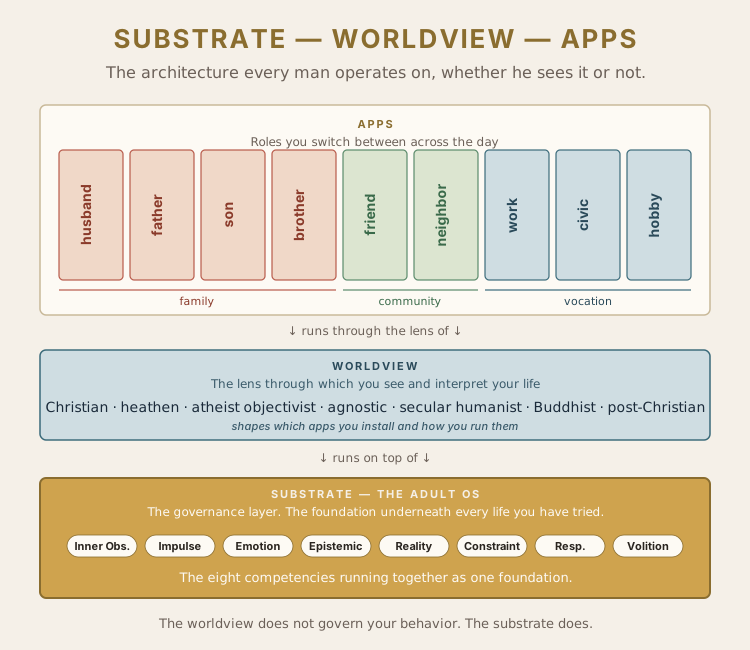
The picture above answers three concerns the audience often brings.
Your worldview sits on the substrate. Both layers stay yours. The Christian, the heathen, the atheist objectivist, the agnostic, the secular humanist, the Buddhist, the post-Christian each sit on the same foundation. Adulthood. You install the foundation with the package. The lens you already hold stays yours. The Christian becomes a more capable Christian. The heathen becomes a more capable heathen. The atheist gets the same skills the others get and uses them his own way. The variant set on the diagram is the visible proof: every variant shares the identical substrate. Only the worldview lens changes.
Your political position sits at the worldview tier. The substrate runs underneath. Whatever position you hold, the substrate runs underneath it. The position is yours to choose. The work is to install the layer that lets you act on it.
You install the layer self-improvement assumed. Productivity systems are apps. Stoicism is a worldview. The gym is an app. NoFap is an app. Each sits at one of the upper two tiers. Each assumed the substrate was already in place. It was not. You install the foundation underneath. You learn the whole stack together, not another piece on top. Self-help adds new programs. Sovereignty Stack installs governance, the ability to rule yourself.
This is the answer to what makes this different from what I have already tried. You have run mindfulness from one source, productivity from another, therapy from a third, training from a fourth. Each one arrived with its own vocabulary, its own timeline, and its own account of what was wrong with you. Nothing joined them.
The joining is what was missing, and it does not live in a better stack of programs. It lives in you: one vocabulary, one order to learn them in, one reading of where you stand, held by the man who has to use them. What you have already done is not wasted investment. The reading is in your brain, waiting for the foundation that makes it work.
The eight skills the substrate is made from.
The substrate is one foundation. It is built from eight trainable skills. The order they install in is fixed.
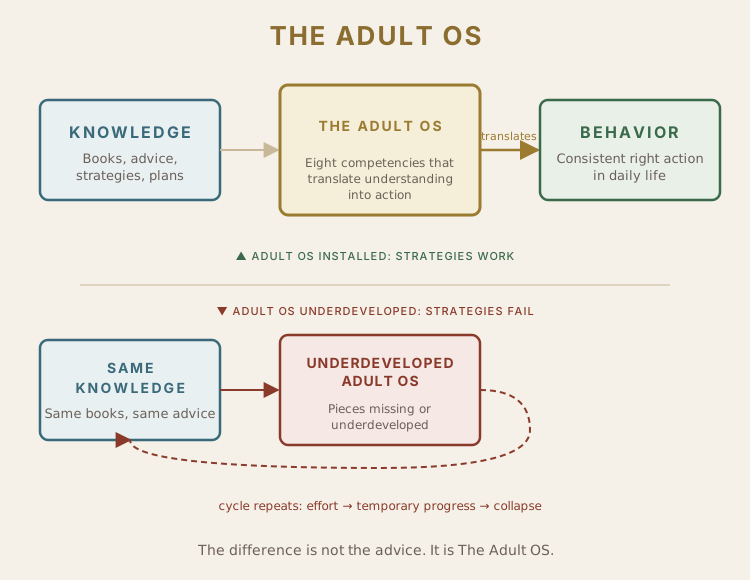
The eight, in fixed order, with what each one is.
- Inner Observer.
- You watch your thinking, your body, and your emotion as they run, without being captured by them. The other seven competencies depend on this one. You cannot stop an impulse you have not noticed. You cannot process an emotion you have not named. You cannot change a belief you cannot see.
- Impulse Modulation.
- You feel an impulse and hold the gap before you act. The throttle, in both directions. Not doing the thing the impulse demands (the substance, the screen, the sharp word, the avoidance). And making yourself do the thing when the impulse is toward comfort, avoidance, or inertia (the email, the workout, the difficult conversation). The two directions use the same governance circuit.
- Emotional Modulation.
- You feel an emotion fully without being controlled by it. You run the Processing Loop: feel, identify, interpret, learn, act, release. You take information from the emotion instead of being hijacked by it or numbing it out.
- Epistemic Updating.
- You change your beliefs when the evidence contradicts them. You treat beliefs as guesses you test against the world. When you are wrong, you change your belief instead of defending it.
- Reality Correspondence.
- You see what is true rather than what you hope or what you fear. Hope builds a plan on the best case, so it collapses on contact; fear builds it on the worst case, so you never start. You compare real things to other real things instead of to imagined ideal versions of them.
- Constraint Subordination.
- You accept real limits and work inside them without resentment. You read which constraints are real, which are phantom, and which can be approached over, under, around, or through. The shift from the system is rigged, I cannot work in it to the system is rigged, I am going to work in the rigging.
- Responsibility Internalization.
- You take responsibility for outcomes without taking on blame for what was not yours to cause. Before you look outward, you ask what you contributed. You may not have caused this. It may not be your fault. You are still the only one who can fix it.
- Strategic Volition.
- You aim at what is worth aiming at and act on the aim. Direction that does not depend on motivation. The previous seven competencies hold you steady. This one points the seven at something specific.
Three things together are why this works where the separate programs did not. Inner Observer is the substrate: the layer the other seven run on, and nothing can be trained until you can see yourself doing it. Under load you do not operate at your average competency, you operate at your weakest one. And the weakest one can be found. You score yourself 0 to 5 on each of the eight. The profile shows which is lowest, and you raise that one using the course. Measure, find the link that governs, raise it, measure again.
The honest objection is that men compensate, and you do. You route the effort around the weak spot and you keep functioning. That routing is the tiring part. The avoidance, the plan that quietly changes shape to skirt the hard conversation, the exhaustion with no single cause you can point at: that is what going around the same weakness for years costs. Compensation is not evidence that the weakest link fails to govern. It is what the governing feels like from the inside.
The dependency is easiest to see one pair at a time. Inner Observer without Reality Correspondence: you watch your own thinking accurately and never test it against the world. Reality Correspondence without Epistemic Updating: you see the evidence plainly and keep the belief anyway. Epistemic Updating without Emotional Modulation: you know you were wrong, the discomfort floods, and the correction never lands. Emotional Modulation without Impulse Modulation: you feel the anger cleanly and send the message anyway. Impulse Modulation without Constraint Subordination: you hold the urge, then spend the strength you saved against a wall that was never going to move. Constraint Subordination without Responsibility Internalization: you accept the limit and hand your part in it to somebody else. Responsibility Internalization without Strategic Volition: you own all of it and aim at none of it.
Trained together, the eight close the gaps in each other. You see it, you test it, you update, you carry the feeling, you act anyway, you work inside what is real, you own your part, and you point the whole of it at something you chose.
You install all eight in fixed order, in dependency sequence, across the year. Section 02 Diagnostics in the first two weeks of the trial gives you the baseline reading: an Eight-Competency Self-Rating that shows where each of the eight stands right now. The reading is your starting picture; the course runs in the same order for every man because the dependencies are the same for every man.
The chain shifts under load over time. Once the year has installed the stack, life puts pressure on it; the weakest link surfaces; you strengthen it; another link surfaces under the next load; you strengthen that one, take on more responsibility, and so on. This is what the cycles in the next section run on.
Read more on the eight competencies, the Adult Operating System, the substrate, and the binding constraint.
Where the eight came from, and what would change them.
The set did not arrive finished. It began at six.
Two tracks tested it. The first was practice: nearly two decades of one-to-one work with hundreds of young men, more than a hundred of them through the material before the set was ever written down as a set. The second was a principled audit, run in March 2026 against one question. What must a foundation of agency support, and does this set cover it? The audit worked from plain principles rather than a school of thought. Men act to acquire what they value. Those pursuits run across time. Thinking serves the pursuit by improving prediction and action. From that, a foundation has to support accurate perception, belief correction, impulse regulation, and strategic acquisition. Its parts have to be distinct. Every part has to be load-bearing.
The audit rejected the set twice. First, on completeness: the six governed how a man thinks and produced no direction across time, so a man could hold all six and still drift. Strategic Volition was added. Second, on prerequisite: meta-awareness had been sitting in the curriculum as a preliminary section, and the audit found that nothing else can be trained without it. Inner Observer came out of that preliminary section and became the first competency. Six became eight because the set failed its own test twice. This is the version that passed.
Why not nine? The job is the filter. A ninth competency has to point at something adult life requires that the eight do not already cover. That is the kind of gap the audit is built to find. It found one once. The invitation stands open to anyone who sees another. The set also stays falsifiable going forward: if men score strong across all eight and still cannot direct their own lives, something is missing and the audit reopens.
What is not claimed here.
- That this is therapy, or a substitute for it. It is education. If something in you is injured, treatment is the right tool for that, and the two do not compete.
- That it replaces your tradition, your philosophy, or your politics. Those sit above the substrate and stay yours.
- That the eight are proven by outcome research. No trial has been run, no success rate is claimed for the course, and the audit that shaped the set is design review rather than proof.
- That the set can never change. It changed twice under testing, and what would change it again is stated above.
The full account is on why these eight. It is written for the program directors who run the course, and it gives the audit’s method, its dates, and the edges of the set.
The year and the cycles.
The year of the course is one cycle. The rest of your life is a sequence of cycles. The substrate is what equips you to run them.
The course runs twelve sections across fifty-two weeks. The first two are the trial (free; card or Bitcoin to start). Section 01 Orientation gives you the frame and the architecture. Section 02 Diagnostics produces three instruments: a pain-pattern reading across twenty life areas, the Eight-Competency Self-Rating (a baseline score per competency you read against your Capstone score at the end of the year), and the Big Five conversational profile. At day fifteen, the first paid month begins and Section 03 Inner Observer opens. The eight competency sections run from there through Section 10 Strategic Volition across roughly forty-six weeks in fixed canonical order. Section 11 Maintenance System installs the protocol that holds the substrate after the year ends. Section 12 Capstone closes the year with five integration exercises and produces the Takeaway PDF, the document you keep permanently.
Inside each section, the teaching runs five disciplines together. The depth gradient: every concept is shown three ways, in plain words, then at the structural level, then in technical terms, so you leave with three usable handles. Immediate application: you apply the concept inside the same lesson, not next week. The three-part activity structure: concept, activity, interpretation. The learning circuit: explain, apply, connect. The spiral structure: each section installs its primary competency and revisits the prior competencies under load. The combination is what installs a skill. Books and videos alone install only understanding.
The year is what it takes. Shorter programs give you understanding without installation. Real attention across your real life across fifty-two weeks is what installs the foundation. The value arrives in week one (you leave Orientation with the architecture in hand and Diagnostics with insight you did not have) and compounds week by week through Section 10.
The year is also one cycle inside a much bigger pattern. Five domains run their own cycles across your adult life: financial, social, vocational, relational, spiritual. Each cycle runs the same kind of question at higher complexity inside greater responsibility. The financial question at seven (a few dollars for candy) becomes the financial question at fourteen (a part-time job), at twenty-one (paying to move out), at twenty-eight (affording a marriage and a household), at thirty-five (affording another child and the schooling that follows), and on through your fifties and sixties. The structure of the question is the same. The complexity climbs each cycle. The other four domains run the same architecture at the same cadence.
The plateau between two cycles is essential preparation for the next phase. What you built in the prior cycle stays with you. It gives you the reserves for the next one. The plateau itself is not the danger. The danger is comfort that turns into stagnation. The plateau is what makes the next ascent possible.
The substrate is yours after the year, regardless of whether you continue the subscription. The Maintenance System teaches the five cadences (daily, weekly, monthly, quarterly, yearly) that hold the substrate without the course’s weekly structure. Subscribers who finish the year and cancel still have the substrate, the protocol, and the Takeaway PDF. Motivation fluctuates. Skills compound.
The next move.
You have the architecture. You have the eight skills the substrate is made from. You have the year and the cycles it runs inside.
If this is the layer you have been looking for, the next move is to begin. The trial opens the first two sections at no charge. You arrive on day fifteen with your pain pattern read across twenty life areas, your Eight-Competency baseline in hand, and the rest of the year laid out in front of you. The year changes you for life because the substrate is yours from the moment it is installed.
If the chapter is what you want to read first, the chapter is here for you. No account, no email. The chapter opens and reads at full depth.
Start the year.
Fourteen days, no charge. One click cancels. The first payment processes on day fifteen when you are ready to begin the year.
Start the year →