A concept from the Sovereignty Stack
The Eight Competencies
The eight trainable skills the Adult Operating System is built from.
The eight competencies are the parts of the foundation. They are not personality traits or talents fixed at birth. They are skills: trainable, measurable, improvable through practice. This page explains what they are, why they install in a fixed order, and what the course does with them.
What they are
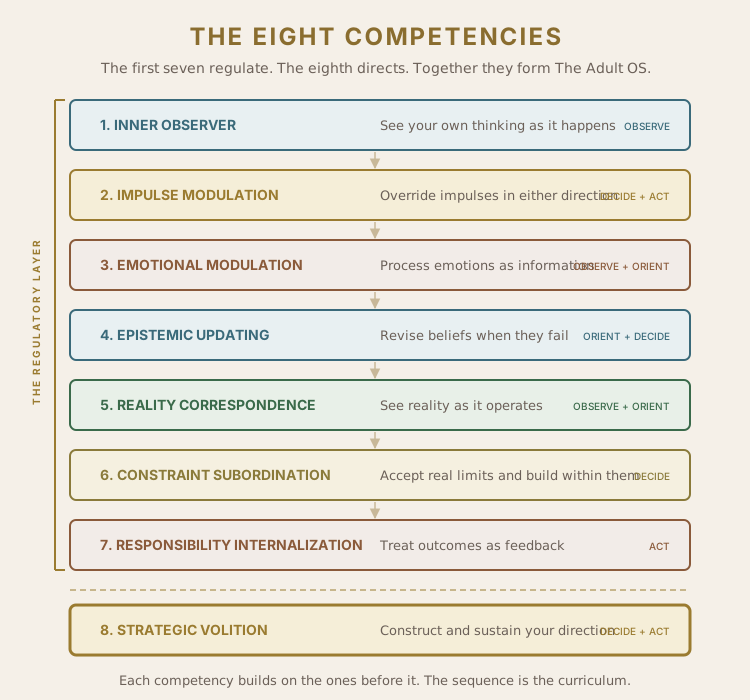
The Adult Operating System is one foundation, built from eight skills. They run continuously beneath every decision, governing what you do before you consciously decide to do it. The eight, in install order:
- 1. Inner Observer. Watching your own mind run without being captured by it.
- 2. Impulse Modulation. Holding the gap between an impulse and the action it demands.
- 3. Emotional Modulation. Feeling an emotion fully without being controlled by it.
- 4. Epistemic Updating. Changing a belief when the evidence contradicts it.
- 5. Reality Correspondence. Seeing what is true rather than what you hope or fear.
- 6. Constraint Subordination. Accepting the limits that are real and working inside them.
- 7. Responsibility Internalization. Treating your outcomes as yours to act on.
- 8. Strategic Volition. Aiming the other seven at something that matters.
The eight, in moments you will recognize
A skill shows itself most clearly in the moments it is missing. None of what follows is a verdict on you; it is what a missing skill looks like from the inside.
Inner Observer
You come in the door, drop the bag, and you are on the couch with the phone inside a minute. Just five minutes, you tell yourself, and forty-five disappear before you notice where they went.
Inner Observer is the capacity to watch your own mind run in real time without being captured by it. It is the layer every other competency runs on: nothing else can be trained until you can see yourself doing it.
When you have it, a gap opens between what happens and what you do next, and in that gap you choose deliberately.
Impulse Modulation
You put the phone down at one in the morning. One more, you think, and your hand has it back before the minute is out. The call you have been avoiding waits for a better mood that never arrives.
Impulse Modulation is holding the gap between an impulse and the action it demands, in both directions: not doing the thing the urge insists on, and doing the thing you do not feel like doing.
When you have it, you feel the pull and keep the promise you made yourself that morning anyway.
Emotional Modulation
You swallow the disagreement whole. Not worth it, you tell yourself. A week later somebody forgets to take the trash out, and what comes out of you is far too large for the trash.
Emotional Modulation is feeling an emotion fully, naming it accurately, and taking the information it carries instead of being run by it.
When you have it, you can be angry without exploding and hurt without going numb, and you say what is wrong while it is still small.
Epistemic Updating
You lose the argument on the merits and reach for a technicality. Technically, you say, and you walk away having won nothing. The plan that has not worked in two years enters its third, because changing it would mean saying out loud that you were wrong in front of the people who watched you commit to it.
Epistemic Updating is changing a belief when the evidence contradicts it, treating what you believe as a guess you test rather than a position you defend.
When you have it, you can be wrong out loud, correct early, and save yourself the wasted years.
Reality Correspondence
You say you want the career, and you spend forty hours a week on the game and two on anything pointing at the career. Or it runs the other way: you can see exactly how it fails, so you never start, and calling that realism makes it easier to carry.
Reality Correspondence is seeing what is true rather than what you hope or what you fear. Both directions distort, and both cost you the same thing.
When you have it, your plans are built on the world as it is, so they hold up when they meet it; and when what you are doing is working, you can trust it and put more into it.
Constraint Subordination
The rule is stupid, you think, and you agree to it out loud and then dodge it sideways for a month. Or you cannot start until the plan is perfect, so you wait, and the waiting looks like standards.
Constraint Subordination is accepting the limits that are real and building inside them instead of against them.
When you have it, you stop spending yourself on what does not move, and that strength goes into what you are actually building.
Responsibility Internalization
You are late, and the first sentence out of your mouth is about the traffic. Different job, different girlfriend, same ending, and what those endings have in common has never once occurred to you.
Responsibility Internalization is treating your outcomes as yours to act on, owning your part without condemning yourself for it.
When you have it, you find the one thing in the situation that is yours to move, and you move it.
Strategic Volition
Two years of telling people about the idea, and nothing registered, nothing built, nothing sold. Eleven days at the gym, one missed alarm, and the whole thing is over.
Strategic Volition is aiming the other seven at something that matters and building toward it on the days motivation is absent.
When you have it, your choices start adding up to something, and the man in the mirror has your respect.
None of that is a verdict on you either. These are skills. Almost nobody is taught them, and every one of the eight can be trained through practice.
Score yourself
The scoring sheet is one page per pair of skills, with six levels described for each of the eight. It takes about fifteen minutes. No account, no email, and nobody sees it but you.
If the profile tells you nothing you did not already know, that is good news. It means you see yourself accurately, and seeing yourself accurately is the first of the eight working.
Why the order is fixed
The order is fixed because the dependencies are fixed. Inner Observer comes first because the rest require it: you cannot stop an impulse you have not noticed, process an emotion you have not named, or change a belief you cannot see. Strategic Volition comes last because it aims the prior seven at something worth doing.
Build them out of order and the later ones have nothing to stand on. This is why the course is a sequence, not a menu.
What you install with the course
The book names the eight and shows you what each one is. You install them one at a time, in order, across a year of structured practice with measurement, so each competency is in place before the next one is built on top of it.
See how the eight fit together and install, or read the full glossary.
Related concepts
- The Adult Operating System — The governance layer underneath behavior.
- The Substrate — The load-bearing layer everything else rests on.
- Personal Sovereignty — Governing yourself through judgment, self-control, and responsibility.
- The Binding Constraint — Your weakest competency, the one that caps the rest.
Written by Noah Revoy, author of the Sovereignty Stack.
Start the year.
You build all eight, in order, until the whole foundation holds. Begin with a fourteen-day trial.
Fourteen days, no charge. One click cancels. The first payment processes on day fifteen when you are ready to begin the year.
Start the 14-day trial →Or start with the book.
The book introduces all eight competencies and the order they depend on.
Get the book →