The second of the eight competencies
Impulse Modulation
Holding the gap between an impulse and the action it demands.
Impulse Modulation is the throttle. It governs both the urge you should refuse and the action you should take when comfort pulls the other way. This page explains what it is, why it sits second, and what changes when you can hold the gap.
What it is
The capacity to feel an impulse and hold the gap before you act. It is the throttle in both directions: refusing the thing the impulse demands, and making yourself do the thing when the impulse pulls toward comfort, avoidance, or inertia. Both directions use the same governance circuit.
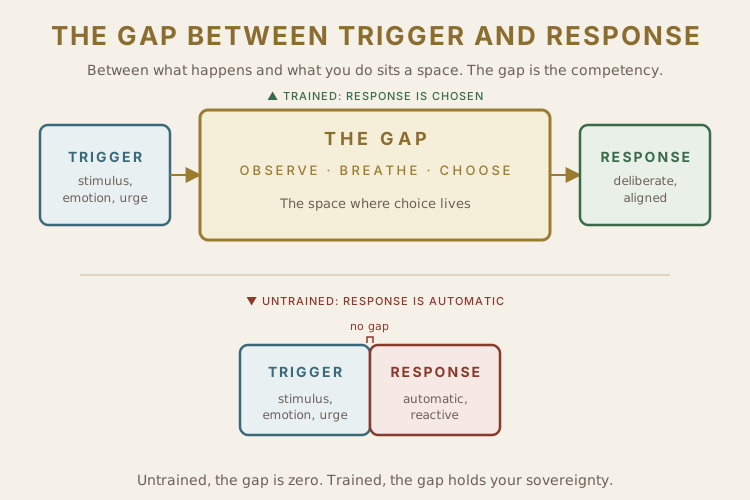
The same circuit refuses the substance, the screen, the sharp word, and the avoidance, and it also makes you send the email, do the workout, and have the difficult conversation. Restraint and follow-through are the same skill pointed in opposite directions.
What does it look like when there is not enough Impulse Modulation? You put the phone down at one in the morning and your hand has it again before the minute is out. The hard errand waits for a better mood that never arrives, then gets done in a panic, or does not get done at all.
Why it sits second
You cannot hold a gap you never noticed opening. Impulse Modulation depends on the Inner Observer, which surfaces the impulse in the first place. Once you can see the urge as it rises, you can put a beat between it and your hands.
What you install with the course
The book explains the throttle. You train it with the course, through structured practice with measurement, in its place among the eight competencies that build the Adult Operating System.
Related concepts
- Inner Observer — Watching your own mind run without being captured by it.
- Emotional Modulation — Feeling an emotion fully without being controlled by it.
- Epistemic Updating — Changing a belief when the evidence contradicts it.
- Reality Correspondence — Seeing what is true rather than what you hope or fear.
Written by Noah Revoy, author of the Sovereignty Stack.
Start the year.
You install the throttle until holding the gap is automatic. Begin with a fourteen-day trial.
Fourteen days, no charge. One click cancels. The first payment processes on day fifteen when you are ready to begin the year.
Start the 14-day trial →Or start with the book.
The book introduces all eight competencies and the order they depend on.
Get the book →