The sixth of the eight competencies
Constraint Subordination
Accepting real limits and working inside them without resentment.
Constraint Subordination is the competency that turns limits from walls into terrain. It is the difference between a man stalled by the rules and a man who reads them and moves. This page explains what it is, why it sits where it does, and what it changes.
What it is
The capacity to accept real limits and work inside them without resentment. You read which constraints are real, which are phantom, and which can be approached over, under, around, or through. It is the shift from the system is rigged and I cannot work in it to the system is rigged and I am going to work in the rigging.
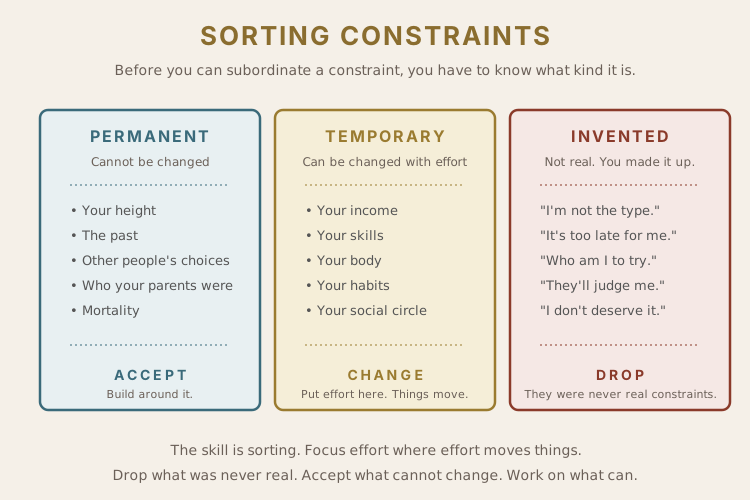
What does it look like when Constraint Subordination is missing? You agree to the rule, then grumble at it, dodge it, and resist it sideways. Or you cannot start until the plan is perfect and the timing is right, so you wait, and the waiting costs more than the rule ever did.
Why it comes here
Telling a real limit from a phantom one requires seeing clearly first, which is why this competency sits above Reality Correspondence. A man who cannot see straight calls every wall permanent or every wall imaginary. Accurate sight comes first; working the constraint comes next.
What you install with the course
The book explains the shift. You train it with the course, through structured practice with measurement, in its place among the eight competencies.
Related concepts
- Inner Observer — Watching your own mind run without being captured by it.
- Impulse Modulation — Holding the gap between an impulse and the action it demands.
- Emotional Modulation — Feeling an emotion fully without being controlled by it.
- Epistemic Updating — Changing a belief when the evidence contradicts it.
Written by Noah Revoy, author of the Sovereignty Stack.
Start the year.
You learn to read limits and work inside them. Begin with a fourteen-day trial.
Fourteen days, no charge. One click cancels. The first payment processes on day fifteen when you are ready to begin the year.
Start the 14-day trial →Or start with the book.
The book introduces all eight competencies and the order they depend on.
Get the book →