A concept from the Sovereignty Stack
The Feelings Wheel
Move from a vague feeling you cannot use to a precise one you can act on.
The feelings wheel is how you learn emotional precision. A vague signal tells you nothing you can do. A precise one tells you who did what and what to do about it. This page explains what the wheel is, why the course is built on it, and what changes when you can name what you feel.
What it is
Most men operate with a vocabulary of five to ten emotion words. That is like trying to describe the world using only primary colors, or to fix an engine with one wrench. Without precision, you cannot act on what you feel. I feel bad tells you nothing. I feel humiliated because my boss corrected me in front of the team, and it hit the same nerve my father used to hit, tells you everything.
The wheel organizes emotions from broad families at the center out to specific variants on the rings. You start at the center with a broad family, then move outward by asking questions that refine the signal until it is specific enough to act on.
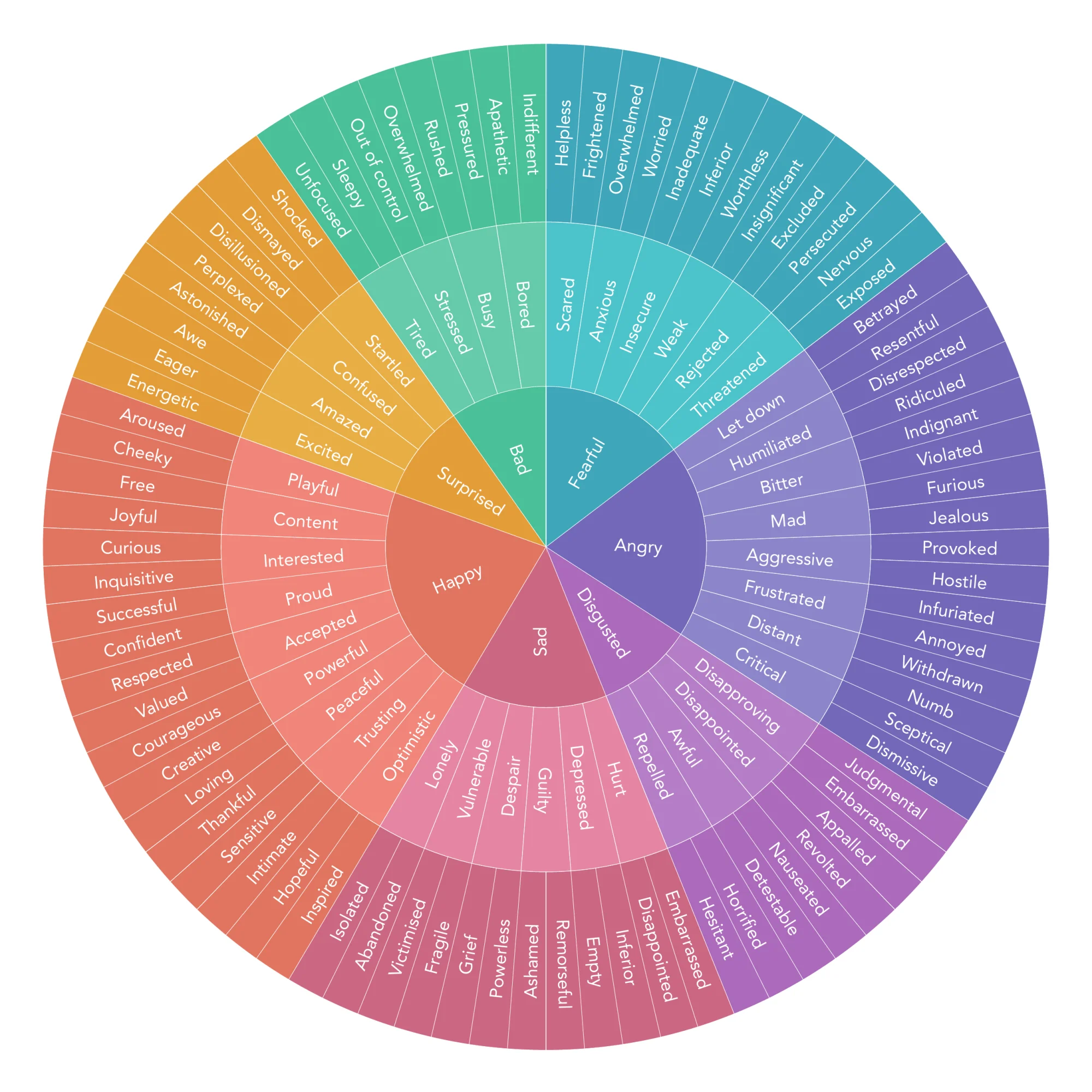
You feel angry. That is the center, and it tells you almost nothing. Angry about what? Someone let you down. What specifically? They made a promise and broke it. Now you are at the rim: betrayed. Angry tells you to lash out at the world. Betrayed tells you who did what, and you can decide whether to confront them, set a boundary, or process the loss of trust. The vague center produces a vague response. The precise rim produces a precise one.
Why the course is built on it
The wheel is the front end of the Processing Loop. You cannot interpret a signal you cannot name, so the wheel powers the Identify step: it turns the raw charge into a word precise enough to read.
Young men in particular are socialized to express anger, because anger is the one emotion that does not look weak. Underneath most of it is fear, shame, grief, or loneliness. Learning to see what the anger is covering is one of the most useful things the wheel teaches.
What you install with the course
The book includes the wheel as a reference. Using it in real time, under load, is a trained skill. You learn the full daily practice: guided disambiguation sessions, a question guide for every emotion on the wheel, and progressive difficulty that builds your vocabulary from a handful of words into a precision instrument.
See the Processing Loop it feeds, how the eight competencies install, or read the full glossary.
Related concepts
- The OODA Loop — The cycle every action runs through.
- The Processing Loop — Turn an emotion into a decision instead of an explosion.
- The Ladder of Truth — Grade a claim from a gut feeling to tested knowledge.
- Two-Axis Belief Evaluation — Is the belief true, and does it help?
Written by Noah Revoy, author of the Sovereignty Stack.
Start the year.
You build your emotional vocabulary from a handful of words into an instrument you can act on. Begin with a fourteen-day trial.
Fourteen days, no charge. One click cancels. The first payment processes on day fifteen when you are ready to begin the year.
Start the 14-day trial →Or start with the book.
The book includes the full wheel and shows you how to trace a vague feeling to the precise one underneath it.
Get the book →