A concept from the Sovereignty Stack
The Processing Loop
The six steps that turn an emotion into a decision instead of an explosion.
The Processing Loop is how you learn to handle emotion: receive the signal, act on it, and let it pass, so it stops accumulating into the outburst that arrives at the wrong time. This page explains what the loop is, why the course is built on it, and what changes when you can run it.
What it is
Emotions are signals. An emotion that is not processed does not disappear. It is stored in the body as unresolved tension, it accumulates, and it distorts perception until it forces expression, usually at the wrong time, in the wrong way, at the wrong target. Processing receives the message the emotion has been trying to deliver. Once the message is received, the intensity diminishes, because the signal has done its job.
The output of processing is better decisions, not better feelings. The feelings improve as a consequence. The six steps:
- Feel.
- Let the emotion register instead of suppressing it.
- Identify.
- Name it precisely. Not bad, but betrayed, ashamed, or afraid.
- Interpret.
- Read the message. What is the signal reporting?
- Learn.
- Decide what it means for your choices.
- Act.
- Take the step the signal called for.
- Release.
- Let the intensity pass. The signal has been received.
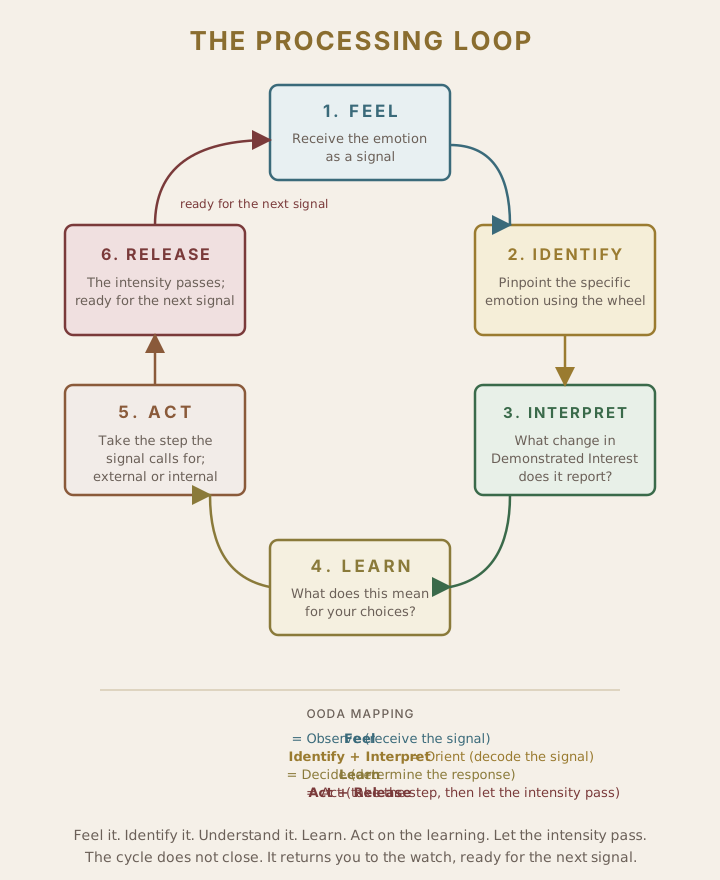
Processing is a line, not a circle. You move through it and the sequence ends. Rumination, by contrast, is replaying a situation without extracting the signal, a loop with no exit. If you are going in circles, you have skipped Interpret, Learn, and Act.
Why the course is built on it
The Processing Loop maps directly onto the OODA loop. Feel is Observe. Identify and Interpret are Orient. Learn is Decide. Act and Release are Act. If you can run an honest debrief on a failed plan, you can run the Processing Loop on an emotion. The mechanism is identical. The input is different.
Emotional Modulation is the competency that runs this loop, and the rest of the work depends on it. You cannot update a belief you are too defended to feel wrong about, and you cannot see reality clearly through an accumulated emotional charge.
The pattern it ends
You have a disagreement with someone important to you. You do not say what you feel. You push it down and move on. A week later something small happens, and your reaction is wildly disproportionate. You explode, or you withdraw, or you say something cutting that surprises even you. The explosion was the unprocessed emotion from a week ago, plus the week before, plus last month. You had been accumulating emotional debt, and the small thing exceeded your carrying capacity.
Or the breakup. She ends it, you go numb, you tell everyone you are fine, and you throw yourself into the gym or work or going out. Three months later you are irritable, your sleep is wrecked, and you snap at people who do not deserve it. The grief is still in your system. You outran it for a while, and now it is catching up.
What you install with the course
Naming the six steps is enough to understand the method. Running it under real emotional load is a trained skill, the same way learning to fight requires sparring, not reading about punches. You install it through six weeks of daily processing sessions with measurement, guided grief and backlog work, and a hijack-prevention protocol for the moments the emotion tries to take the wheel.
See the OODA loop it mirrors, how the eight competencies install, or read the full glossary.
Related concepts
- The OODA Loop — The cycle every action runs through.
- The Feelings Wheel — From a vague feeling to one you can act on.
- The Ladder of Truth — Grade a claim from a gut feeling to tested knowledge.
- Two-Axis Belief Evaluation — Is the belief true, and does it help?
Written by Noah Revoy, author of the Sovereignty Stack.
Start the year.
Six weeks of practice install the Processing Loop until you run it without thinking. Begin with a fourteen-day trial.
Fourteen days, no charge. One click cancels. The first payment processes on day fifteen when you are ready to begin the year.
Start the 14-day trial →Or start with the book.
The book explains the six steps in full and shows you how to begin applying them to individual emotions.
Get the book →