A concept from the Sovereignty Stack
The OODA Loop
The cycle every action runs through, whether you are aware of it or not.
The OODA loop is the spine of the Sovereignty Stack course. The eight competencies you install are the machinery that keeps the loop running clean. This page explains what the loop is, why the course is built on it, and what you get when each phase works.
What it is
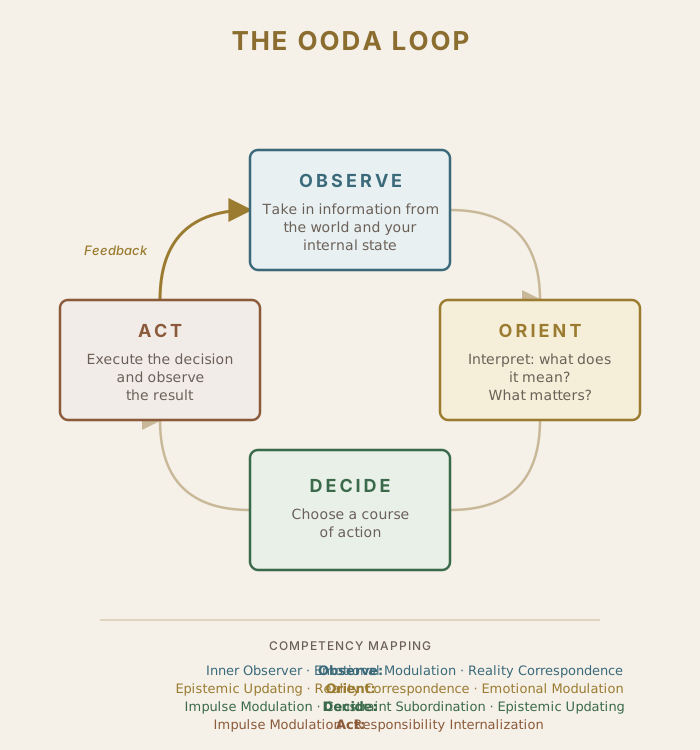
Every action you take follows a cycle, whether you are aware of it or not.
- Observe.
- You take in information from the world and from your own internal state.
- Orient.
- You interpret that information. What does it mean? What matters?
- Decide.
- You choose a course of action based on your interpretation.
- Act.
- You execute the decision and observe the result.
Then the cycle begins again. This is the OODA loop, and it runs continuously at every scale of your life: the micro-decisions of a single conversation, the weekly rhythm of your schedule, the yearly arc of your career.
Where the loop comes from
The loop comes from military strategy. John Boyd, a fighter pilot and strategist, called it the OODA loop. Fighter pilots use it to process reality faster than their opponents.
In combat, the pilot who runs the loop faster acts again before the other man has finished orienting to the last move. His opponent is always answering a situation that has already changed. That is outcycling an opponent.
On most days you have no human opponent standing in front of you. You are still in a race against time, limited resources, your own aging, and entropy. You also compete with other people for many of the same resources and opportunities. You need to outthink your problems at the very least, even when you are not trying to outthink another person.
Why the course is built on it
You run multiple OODA loops at once. A short loop processes a conversation in real time, cycling every few seconds. A longer loop processes your career, cycling over weeks. A longer loop still processes your life direction, cycling over months and years. All of them run concurrently, and the quality of all of them depends on the same eight competencies.
Sometimes you run several loops on the same subject at different timescales. Take a woman you are dating. The short loop calibrates your response to what she just said. The medium loop evaluates whether the relationship has a future. The long loop asks whether pursuing a relationship serves the direction you are building.
When your life is working, the loops run smoothly. When your life is stuck, a loop is jammed at a specific point, because a specific competency is failing.
This is why you learn the eight competencies and not a list of tips. Each phase of the loop is served by particular competencies. Find the phase where you jam, and you have found the competency to train.
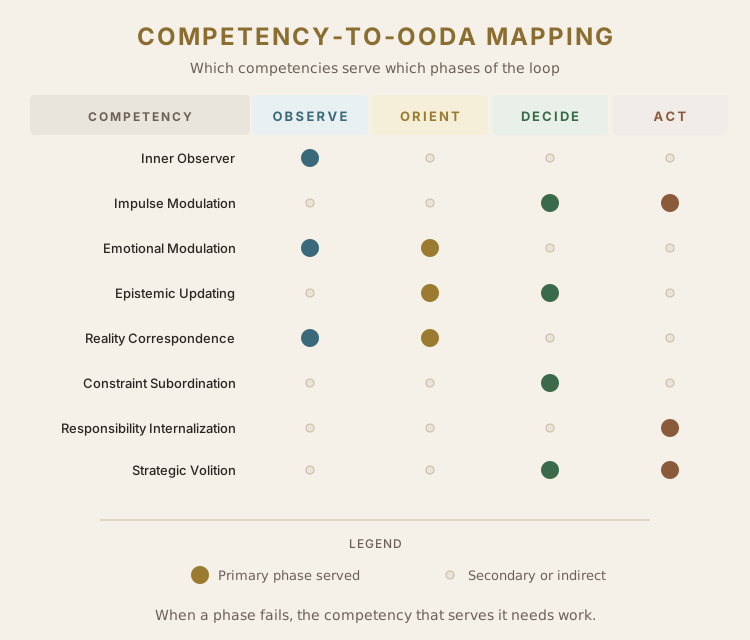
| Loop phase | Competencies that serve it | What failure looks like |
|---|---|---|
| Observe | Inner Observer, Emotional Modulation, Reality Correspondence | You do not see what is happening, or you see it through a distortion. |
| Orient | Epistemic Updating, Reality Correspondence, Emotional Modulation, Strategic Volition | You misinterpret what you see. Your model of the situation is outdated or built on unexamined beliefs. |
| Decide | Impulse Modulation, Constraint Subordination, Epistemic Updating, Strategic Volition | You know what to do but cannot make yourself choose it, or you choose based on how you wish things were. |
| Act | Impulse Modulation, Responsibility Internalization | You do not follow through, or you act and refuse to learn from the result. |
What happens in the Orient phase
In the Orient phase you interpret what you observed. Your beliefs, your past experience, your current goals, and your identity exert the most influence here. If your orientation is misaligned, your decisions will be poor even when your execution is disciplined.
Distortion at Orient is the most common failure across all eight competencies. Sometimes you skip the phase entirely. You react, see the result, and react again. The same problem recurs because you never pause to interpret what you observed or to choose a different course of action.
Find where yours jams
You are in a conversation with a woman you are attracted to and you cannot think straight. You are not observing her signals, your own emotions, or the back-and-forth between you. You are reacting. That is an observation failure.
You got rejected from a job and concluded that the system is rigged. You oriented what to do about it on a narrative you absorbed online, not on evidence from your own life. That is an orientation failure.
You signed a lease without reading the guarantor clauses. You accepted a credit card without checking the APR. You oriented your financial decisions on the assumption that the details did not matter. Now you are paying for someone else’s literacy. That is an orientation failure built on information you never gathered.
You know you ought to apply for the better job, leave the toxic friend group, stop gaming until three in the morning. You cannot bring yourself to decide. You sit in the same loop, week after week, because deciding means risking failure. That is a decision failure.
Someone is treating you unfairly. You can see it clearly. You know you ought to stand up for yourself and say something. You freeze, because you cannot decide what to say. The moment passes. You walk away angry at yourself for staying silent. That is also a decision failure.
You decided to start going to the gym. You went twice. Then you did not go, and you did not learn anything from the failure. That is an action failure.
What you install with the course
You install the eight competencies in fixed order with the Sovereignty Stack course, across one year of practice. Each one strengthens a phase of the loop. As the competencies come in, the jams clear: you see what is in front of you, you interpret it against evidence, you decide without freezing, and you follow through and learn from the result.
The fixed order starts with the Inner Observer, the competency that serves the Observe phase. Observation is the foundation. You cannot throttle an impulse you have not seen, or process an emotion you have not noticed. Distortion at Observe corrupts every phase that follows.
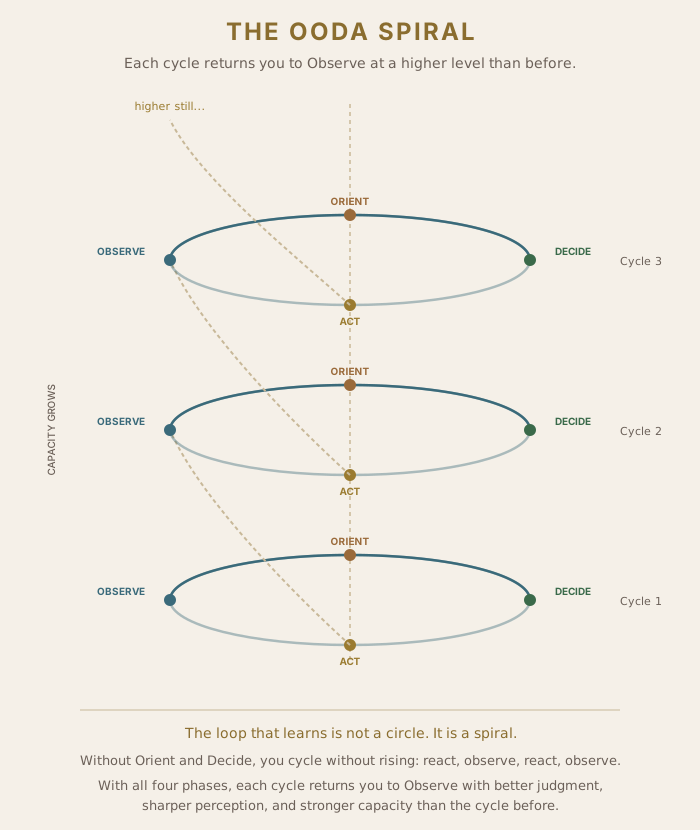
The loops do not just run smoother once. They compound. A clean loop this week sets up a cleaner loop the next, at every timescale, until the whole arc of your life starts answering to you instead of running on its own.
See how the eight competencies fit together and install, or read the full glossary.
Related concepts
- The Processing Loop — Turn an emotion into a decision instead of an explosion.
- The Emotional Wheel — From a vague feeling to one you can act on.
- The Ladder of Truth — Grade a claim from a gut feeling to tested knowledge.
- Two-Axis Belief Evaluation — Is the belief true, and does it help?
Written by Noah Revoy, author of the Sovereignty Stack.
Start the year.
You install the eight competencies that keep your loops clean. Begin with a fourteen-day trial.
Fourteen days, no charge. One click cancels. The first payment processes on day fifteen when you are ready to begin the year.
Or start with the book.
The book makes the case for the Adult Operating System and shows you the loop and the eight competencies in full.
Get the book →