A concept from the Sovereignty Stack
The Ladder of Truth
Before you ask how sure you are, ask what kind of claim you are holding.
The Ladder of Truth is how you learn to grade a claim before you act on it. It sorts what you think into five rungs, from a gut feeling up to tested knowledge, so you hold each one with the grip it has earned. This page explains what the ladder is, why the course is built on it, and what changes when you use it.
What it is
Before asking how confident you are, ask what kind of claim this is. The rungs run from weakest to strongest:
- Intuition.
- A gut feeling. Pre-rational, untested. It may be accurate, or noise.
- Belief.
- A conviction accepted without full testing. Most people operate here.
- Opinion.
- A tentative rational claim, thought about but held lightly.
- Theory.
- A falsifiable explanation that connects cause to effect and predicts.
- Knowledge.
- A claim that has survived repeated testing. Act on it with low risk.
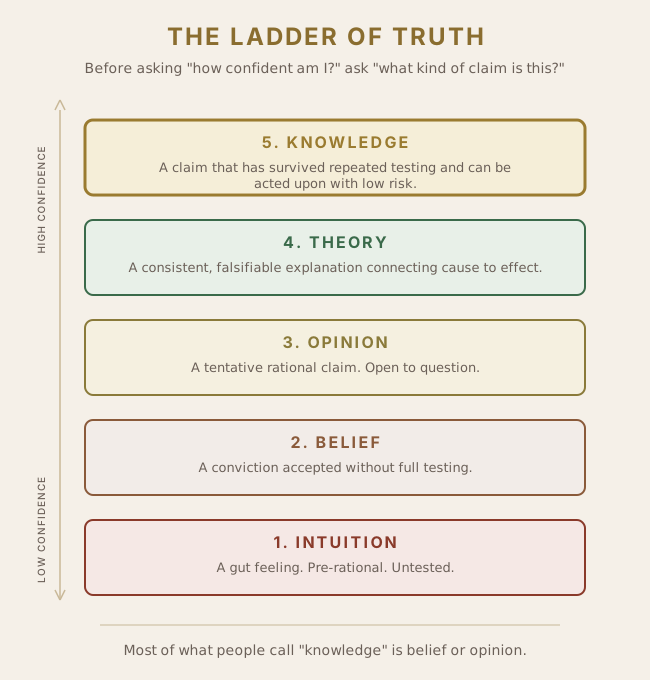
Most of what people call knowledge is belief or opinion. The man who says women only want the top ten percent of men is almost certainly expressing a belief absorbed from a content stream, not knowledge derived from tested experience. The classification alone forces honesty. It does not require you to discard the claim. It requires you to hold it with the appropriate grip.
Why the course is built on it
Epistemic Updating is the competency of changing a belief when the evidence contradicts it, and it cannot run on claims you have never sorted. The ladder is the first move: it separates the convictions you have tested from the ones you merely absorbed. Once you can see which is which, you can update the weak ones instead of defending them.
Truth wins in the long run. A person operating on an accurate map outperforms a person operating on a comforting one, because reality does not adjust itself to accommodate the fiction. Every month on a wrong belief compounds cost. Every month on an accurate one compounds gain.
What you install with the course
Knowing the five rungs is enough to start grading your claims. Turning that into a standing habit, across the beliefs that actually run your money, your relationships, and your self-worth, is the work you do with the course: a guided belief audit, the structured update process, and the practice of catching a claim and placing it on the ladder before you act.
See how the eight competencies install, or read the full glossary.
Related concepts
- The OODA Loop — The cycle every action runs through.
- The Processing Loop — Turn an emotion into a decision instead of an explosion.
- The Feelings Wheel — From a vague feeling to one you can act on.
- Two-Axis Belief Evaluation — Is the belief true, and does it help?
Written by Noah Revoy, author of the Sovereignty Stack.
Start the year.
You install the habit of grading a claim before you trust it. Begin with a fourteen-day trial.
Fourteen days, no charge. One click cancels. The first payment processes on day fifteen when you are ready to begin the year.
Start the 14-day trial →Or start with the book.
The book lays out the ladder and the two-axis evaluation that goes with it, and makes the case for an accurate map over a comfortable one.
Get the book →