A concept from the Sovereignty Stack
Two-Axis Belief Evaluation
Judge a belief on two questions at once: is it true, and does it help?
Two-axis evaluation is how you learn to see why a belief is hard to change. Truth is only one axis. The other is whether the belief helps or hinders your life, and the combination explains the beliefs you cannot seem to drop. This page explains what the framework is, why the course is built on it, and what changes when you use it.
What it is
A belief sits on two independent axes. One is truth value: whether it is true or false. The other is functional value: whether it helps or hinders your life. Plotting both at once produces four quadrants, and the two off-diagonal corners are where people get stuck.
Some false beliefs resist update because they provide real functional value. The thought that you are the best candidate for a job may be false, yet it may produce the confidence that earns you the role. False and helpful: a noble lie. Some true beliefs are hard to accept because they impose costs. That you are not yet qualified may be accurate, but if it stops you from trying, it costs you the growth the attempt would have produced. True and harmful: accurate but functionally costly.
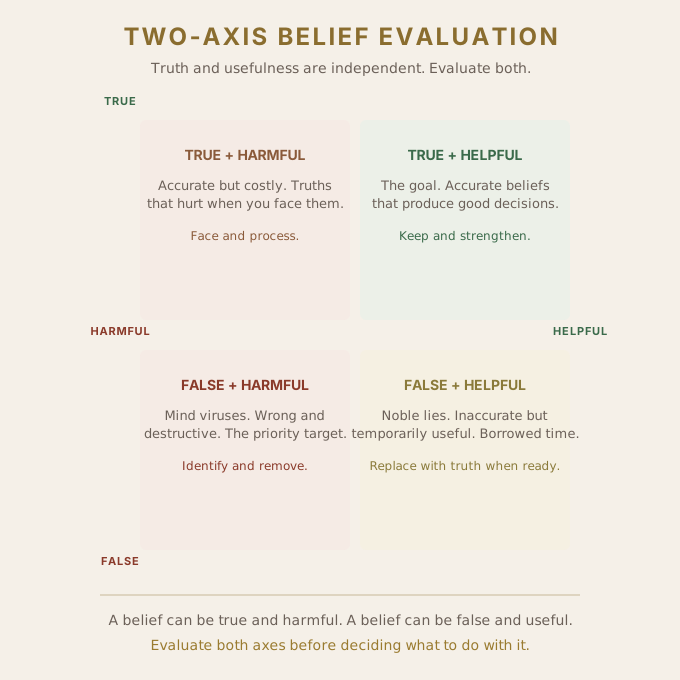
The noble lie deserves care. If a comforting false belief is load-bearing in your psychology, you do not knock the foundation down with nothing to replace it. You honor what it did for you, build a truer belief that serves the same function, and let the fiction go once the replacement holds. An I-cannot-do-this lie becomes an I-could-do-this-if-I-did-what-it-requires truth.
Why the course is built on it
A single true-or-false view cannot explain why you keep a belief you half-know is wrong. The second axis can. Once you can see that a belief is false but functionally load-bearing, you stop trying to argue yourself out of it and start building the replacement that lets it go. That is the difference between knowing you are wrong and actually updating.
Truth wins in the long run. The advantage of a comfortable lie is borrowed time. The advantage of an accurate belief compounds. The arithmetic is relentless.
What you install with the course
Seeing the four quadrants is enough to spot a noble lie. Dismantling one safely, without collapsing the function it was holding up, is the work you do with the course: locating your load-bearing fictions, building the truer beliefs that replace them, and running the update so the change holds instead of snapping back.
This pairs with the Ladder of Truth. See how the eight competencies install, or read the full glossary.
Related concepts
- The OODA Loop — The cycle every action runs through.
- The Processing Loop — Turn an emotion into a decision instead of an explosion.
- The Feelings Wheel — From a vague feeling to one you can act on.
- The Ladder of Truth — Grade a claim from a gut feeling to tested knowledge.
Written by Noah Revoy, author of the Sovereignty Stack.
Start the year.
You install the habit of seeing both axes, so you can finally update the beliefs that have been holding you back. Begin with a fourteen-day trial.
Fourteen days, no charge. One click cancels. The first payment processes on day fifteen when you are ready to begin the year.
Start the 14-day trial →Or start with the book.
The book lays out both axes, the noble lie, and the rule for replacing a fiction before you let it go.
Get the book →